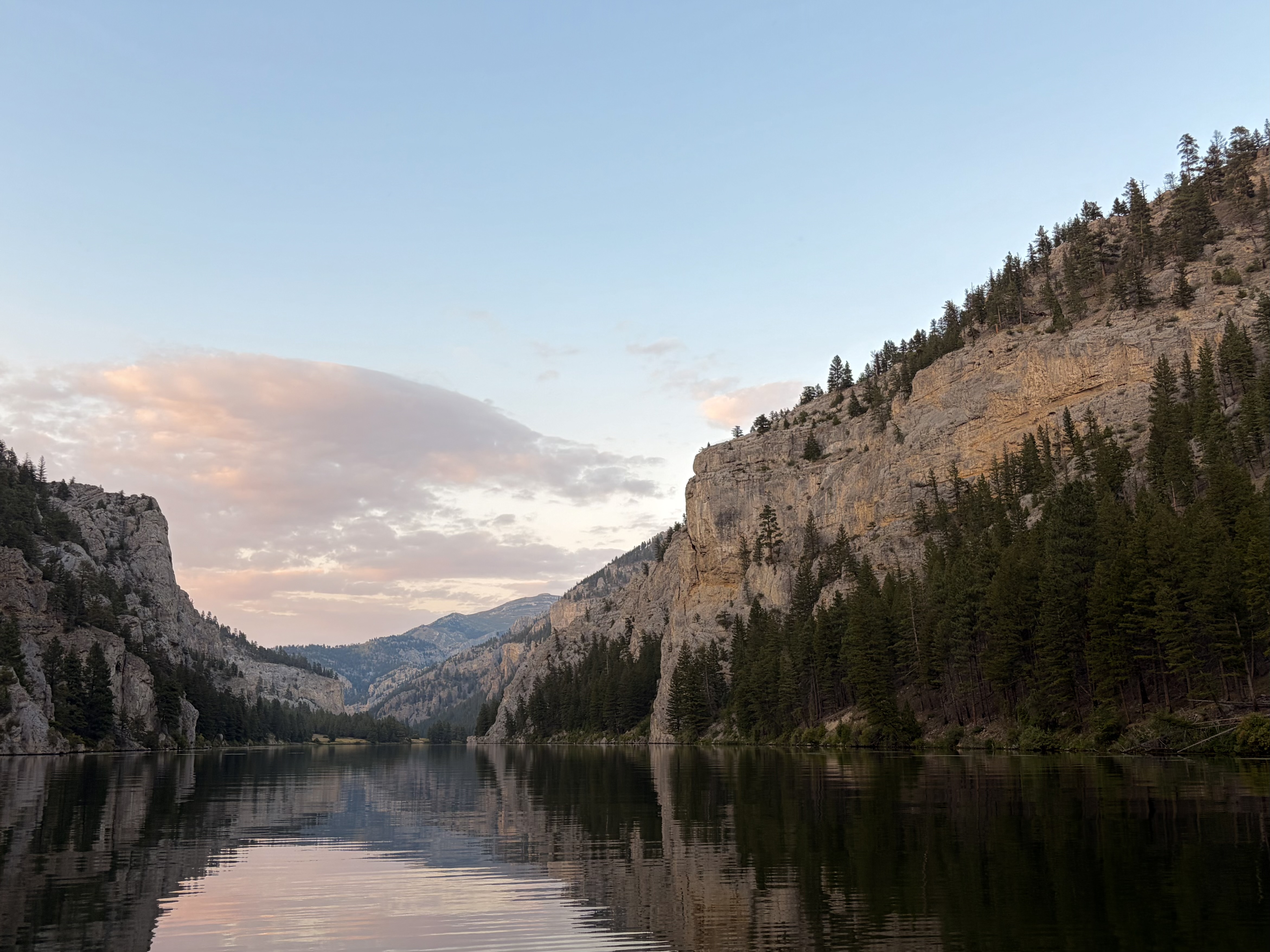
Other than the tens of thousands of bats, we had the canyon to ourselves. Just The Middle Daughter (TMD) and I, plus our 55 new friends. Among the group were a bat specialist, the captain of the Sacajawea II, an FWP non-game biologist, a former state legislator, and a few dozen other folks simply hoping to see bats perform their nightly emergence and streak across the water of the Missouri River in the area known as Gates of the Mountains.
Our guide handed out bat detectors – small electronic devices that listen in the 20 to 120 kHz range (well above human hearing) and amplify the calls. TMD and I managed the large red spotlights that would help illuminate the bats once the colony started to pass us.
On our trip out the viewing area, we had seen Spotted Sandpipers, Bald Eagles sparring with Osprey, Great Blue Herons, Turkey Vultures, and more. A few fish had broken the surface. Our captain pointed out Mule Deer and quipped that if people wanted to see more, they should head to downtown Helena. Then the Captain turned us around and killed the engine.
The soaring limestone cliffs, nearly flat water, and a sunset complete with a crescent moon and a remarkably windless evening set the stage for the coming attraction. Our boat, the Sacajawea II, is 70 years young according to our captain, and fully open on top and sides for viewing. As the gathering darkness closed in around us, everyone was quiet, but on alert.
It all started with the first utterance of “Bat!” One lone bat flew overhead. Our guide said, “OK, switch the bat detectors on.” A few soft clicks sounded. Then the detectors started popping in earnest as a few dozen bats streamed past us, heading upstream toward the open lake and their nightly feeding frenzy. Within a couple of minutes, thousands of bats every minute were flying past us at eye level. The low-flying bats were the smaller species, such as Little Brown Myotis, emitting higher-frequency clicks.
The clicks start out as a slow, steady rhythm that increases in speed as the bats close in on their insect prey. Near the final moment of the insect’s existence, the rapid sequence of echolocation calls sounds like a zipper.
Echolocation is amazing. Even with a huge colony in flightand each bat calling out, we would have heard nothing at all were it not for the good graces of Montana Fish, Wildlife & Parks providing this terrific technology and planning these outings. The boat was filled with clicking, zippering, and low shouts of glee from folks watching an emergence that rivals Freezeout Lake’s spring goose and swan migration.
Between the myriad warm-hued flashlights and our red spotlights, we could see fifty to sixty bats passing through the beams every second on both sides of the boat, nonstop for more than 20 minutes. Some dipped their lower jaw into the water to drink; others pirouetted to catch a mosquito here or a moth there. Nonstop for 20 or more minutes – we completely lost track of time.
Looking upward, we could see the larger, higher-flying bats silhouetted against the dim sky. These were larger species like the Big Brown Bat, Silver-haired, and Hoary Bats.
Along the way, and then out over the lake, these wonderful little mammals were each reducing the bug population by the thousands every night. It is estimated that bats provide more than $650 million in value to Montana agriculture through natural pest control and by reducing biting insects that carry disease. Thanks, bats!
As if that spectacle of nature weren’t enough, when we returned to land, the pavilion had a few bats roosting inside. Again, we lit up the soft-hued lights to help the humans – who can’t see in the dark or hear high frequencies – observe. Posters and stickers were handed out to happy, newly minted bat fans, and then everyone headed home. Two and half hours of deep nature engagement with 50 plus people. That was amazing.
But wait, there’s more.
On the drive back, TMD said, “Wait! That was a snake!” We turned around and went back to find a beautiful three-to-four-foot Prairie Rattlesnake warming himself on the pavement. Our FWP guide stopped when he saw us and identified it as a male. He tried, rather unsuccessfully, to shoo the snake off the road, but the snake liked the warmth and wouldn’t budge. And one simply doesn’t argue with a rattlesnake.
And the view of Milky Way was pretty cool, too!
So, that was our Tuesday evening – immersing ourselves in the wonder of nature that Montana provides.
The boat tours are sold out for 2026, but next May, you can sign up to try this out for yourself.


Leave a Reply