Here in Helena, we are blessed with an abundance of birds. From the back porch feeders to our high ridges, birds are our nearly constant companions. Several times out in the field, I’ve had someone refer to me as a birdwatcher. I always silently bristle just a little, because I was out in a field on a trail, with a bit of gear, and it is often cold, or windy, or hot, or raining. I have always preferred the term birder.
Recently, I was walking with the Labrador and my mind wandered back around to this question – “Am I a ‘birdwatcher’ or a ‘birder’?” “What’s the actual difference?” and “Who really cares?”
I have these thoughts when I am out and about. Since I seem to care, I thought I’d share my thoughts – though no one asked.
We (the royal we, that is) have a funny way with words. Most people say “tuna fish” rather than just “tuna.” We also collectively accept that fishing implies an active pursuit—the act of going out to actually catch, or at least try to catch, fish. We don’t say “i’m going to go fish catching, ro line casting; we go fishing. I believe we should apply that same logic to pusuits involving our feathered friends.
I recently read an article attempting to distinguish birding from birdwatching, but to my way of thinking, it missed the mark.
Like so many things in life, engaging with birds is not an either/or situation. I see the two terms not as separate boxes to check, but existing along a spectrum defined by two qualities: Intentionality and Effort. While both activities culminate in looking at a bird, I believe they are differentiated based on the participant’s “mental why” and “physical how.”
Think of a line of points on a graph. As your Intentionality (the specific goal of seeing a bird) goes up, the likelihood that you are birding rises. As the Effort (the physical activity level) trends downward, birdwatching is the likely moniker. But even here, there are nuances. Because there are always nuances.
- Birdwatching tends to be Low to Moderate effort. Think “soft and warm.” Casual and contemplative; enjoyed from a deck or patio with a glass of good beer or wine.
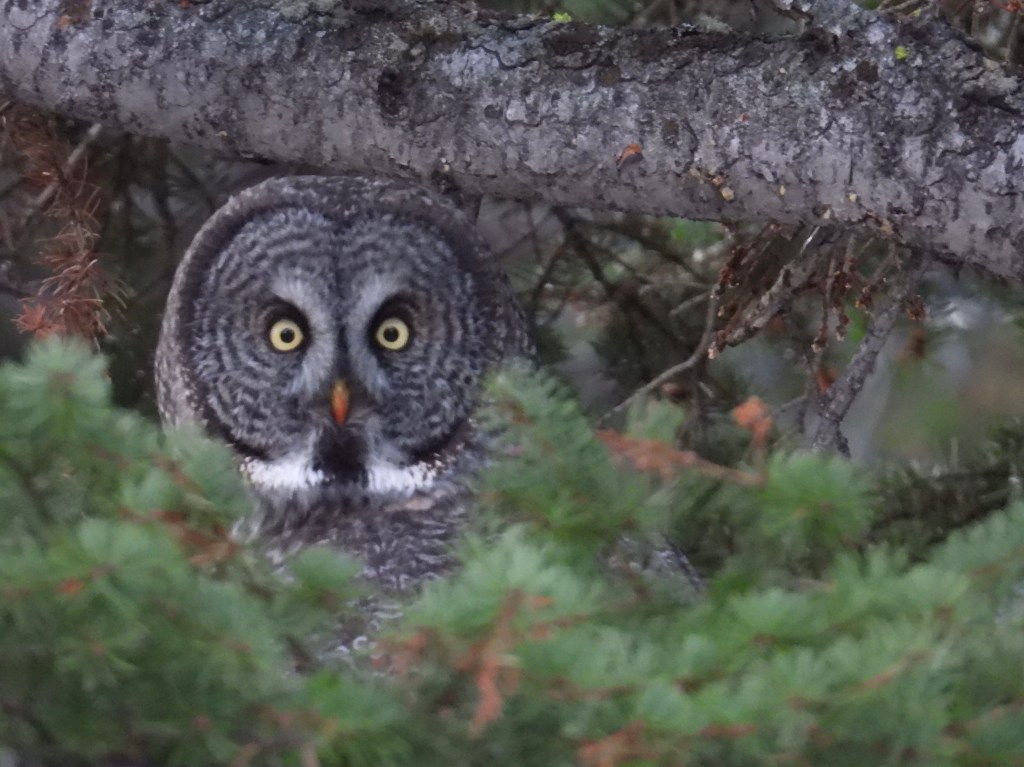
- Incidental Watching can be Low on the intention scale, and low on the effort scale, particularly when it is secondary to the main reason for the outing – think about floating on a river and seeing a belted kingfisher plying its trade. It can also be Moderate to High. For instance, when birds are the unintended byproduct of another activity, like seeing a Great Grey owl while out on a hike.
- Birding tends to be High when finding and seeing Birds is the Primary Goal. High. This is sort of the “Fishing” end of the scale. Active, energetic, and purposeful pursuit of specific species.
- Transitional can be both High – related to he Primary Goal. And then low once you have the payoff. For instance, sitting quietly to observe the rare species you worked so hard to find.
To my way of thinking, birdwatching is, figuratively speaking, soft and warm. It requires less in the way of effort. It happens when you are sitting in your yard or home and can see the feeder. At this level, it is a casual, contemplative session—either purposeful or accidental.
Birding, on the other hand, is sort of the “Fishing” of the bird world. It is a mind exercise or “scientific sport” where seeing birds is the main purpose of the visit to the field. Just as a fisherman sets out with a rod and a target area to try his or her luck, a birder sets out with binoculars and a target area to find a species or number of species.
So, these two states are fluid. You might undertake a strenuous hike specifically to find Grey-crowned Rosy Finches and, you will almost certainly identify as many species as possible along the way. During this stage of the game, you are clearly birding. However, once you sit and have a snack on the side of a mountain while watching those those rarely seen finches scratching at the snow and dirt, you have shifted—plain and simply—to birdwatching.
By using my definitions, most of what I do is incidental birding. I spend at least an hour every day in parks or on trails around the valley with my labrador. If I am on a trail, I always have my camera, binoculars, and my phone (with its many nature apps). When I hear or see a bird I can’t quickly ID, or which is new for me or unexpected in the area, I stop and watch, take pictures and often record the encounter.
Birdwatching and birding, while closely related, exist in an inverse relationship. The more that birds are the reason for the effort being expended, the more likely you are birding. The more birds are just passing through the scene while you simply enjoy being in their presence, the more likely you are birdwatching.
One is the pursuit; the other is the presence.
 Nature, every day.
Leave a Reply