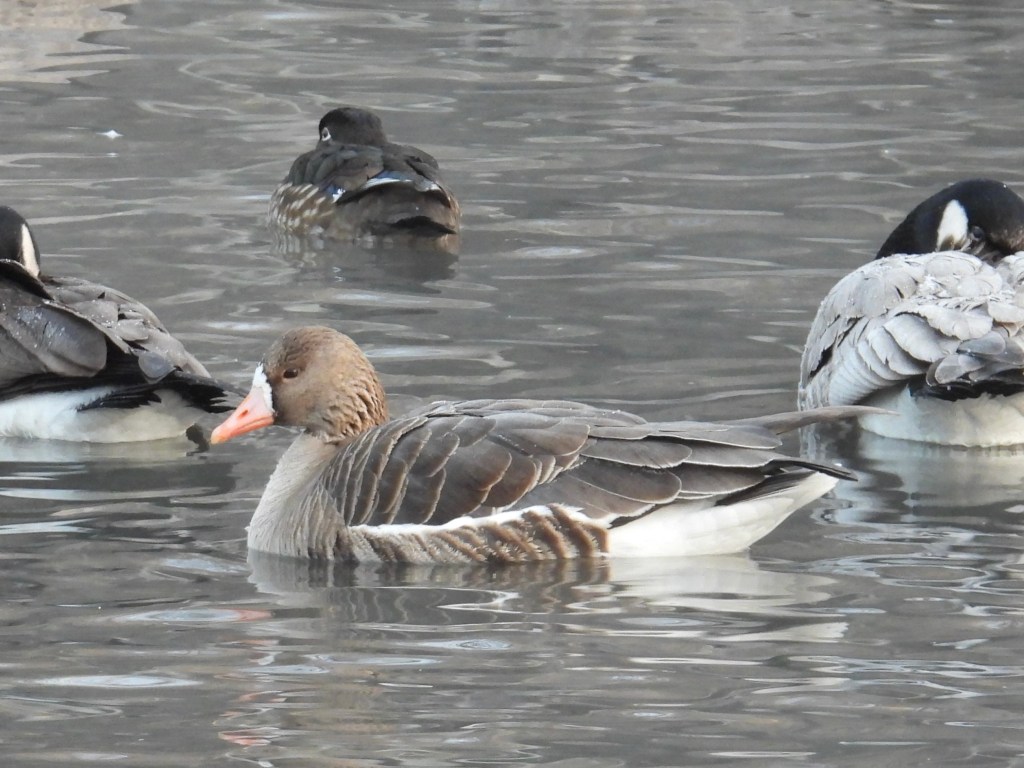
Montana is home to five native goose species. According to the definitive book Birds of Montana (Marks, Hendricks, and Casey), the list includes the Canada, Cackling, Snow, Ross’s, and Greater White-fronted goose. While the Greater White-fronted goose is uncommon across most of the state, it is a frequent visitor to Northeast Montana during the spring migration. (A sixth, the Barnacle Goose, is technically listed by the State of Montana as native but is considered an “accidental” visitor from the North Atlantic oceanic regions.)
Earlier today, my middle daughter and I had the rare privilege of seeing all five primary species at once.
There is something deeply rewarding about sharing any nature experience with family and sharing a rare sighting is even better. So, seeing Montana’s goose “quintet”—or perhaps “quintfecta,” as it felt like a celebratory win for us – in Helena, in January, felt monumental. Spotting them all simultaneously at the L&C County Fairgrounds was a rare alignment of migration, mild weather patterns, and luck that neither of us will soon forget.
Our experience also highlights the wonderful intersection of community and technology—the heart of citizen science.
Birders are a curious lot, both literally and figuratively. We are curious enough to head into the field regardless of the weather, engaging with nature rather than just passing through it. To the outside observer, we might seem “curious” in the figurative sense, too: our cars are often coated in a grey-brown patina of backroad dirt, and we’re rarely seen without optics, foul-weather gear, or the tendency to abruptly pull over and stare into a field with binoculars.
Birders also like to connect and share their sightings. Through local clubs, WhatsApp groups, and apps like eBird, Birds, and iNaturalist, we stay in orbit of one another. Many of us receive a daily “Rare Bird Alert” in our inboxes—the spark for quite a few sudden birding excursions in my household.
When the alert for a Greater White-fronted goose arrived last week, I realized it was being spotted just minutes from home. Even more intriguing: the location was a site where the other four species had been seen multiple times over the last month.
I went to bed hoping they would all still be there in the morning.
Standing at the pond on January 22, it all came together. It wasn’t just about the birds; it was an opportunity to reconnect with the local birding community in person. Over the years, we’ve shared similar “rendezvous” over Great Grey, Long-eared, and Short-eared owls, Long-tailed ducks, Eastern Bluebirds, several different warblers and more. And since many of the local birders are retired, they are always quite happy to see my daughter, a Gen Z’er, out and about enjoying birding along side them all.
I had a high school science teacher who boiled down the scientific method to a simple phrase: “Scientists observe and report.” I’ve never forgotten that. Whether it’s recording data in a repository or sharing photos on Instagram, this process of observation and camaraderie keeps us informed about the world around us.
Citizen science, community engagement, a bit of quality time outdoors, and a rare encounter – I can’t think of a better way to spend a Montana morning. Lastly, it was only about 10 degrees and both my daughter and I needed to call in to our workplaces that we might be a few minutes late because we went to see a rare bird.
Curious, indeed!
 Nature, every day.
Leave a Reply