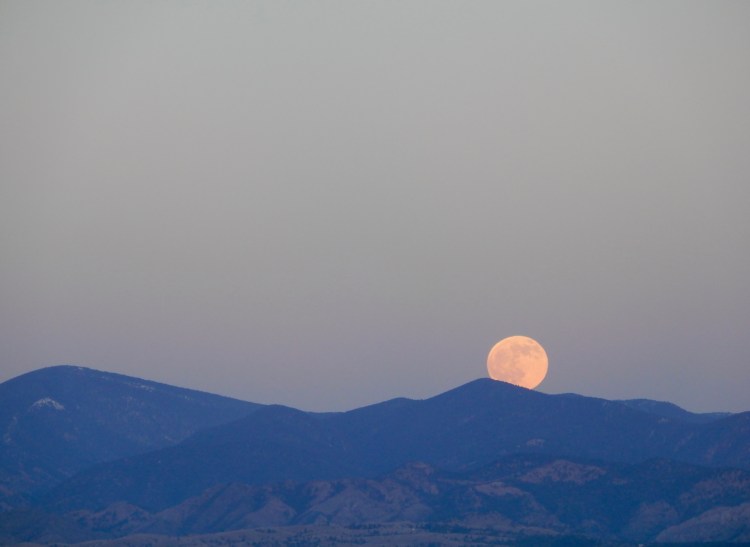
This has been a good year to watch the skies. Since mid Feb, I have seen so many wonderful scenes unfold in the dark skies over my little corner of the word. From meteors, to comets; from planetary conjunctions, to the latest, 13th, and final, full moon of the year. There have been sunsets and sunrises worth stopping and fawning over, and there have been sun-dogs a few times, as well.
Next year, 2021 looks to be pretty good as well. There are at least a few night sky events that that I would like to see- a couple will be too far and too hard foe me to get to, but I hope others take the time to observe and comment about them.
Feb 11- Venus and Jupiter will form a conjunction
Might be too far south for me to see, but early morning and looking in the SE sky might show this.
Mar 9 and 10- There will be a Quadruple Formation
Mercury, Jupiter, Saturn, and the crescent moon will all appear together in the SE sky in the very early morning.
May 26- Blood Moon total eclipse
Around 2:45am in the Mountain Time zone of the US, the eclipse will begin. It should be over by 4:25am. Totality – and the deep red color – should be reached at 4:11 Mountain Time.
Jun 10- Ring of Fire solar eclipse
Too far north for me, but it looks like something to see someday!
July 12- Venus and Mars form a conjunction
This is billed as being like a mini great-conjunction. Mars may be a little hard to see at first, but Venus is always easy to find, clouds notwithstanding.
Aug 12- Perseid meteor shower begins
Coming out of the NE sky, this year looks to be good. The moonless sky will help terrifically as we cruise through the debris that follows Comet Swift-Tuttle.
Aug 18- Mars and Mercury form a conjunction
This will be really hard to see- Mercury is SO close to the sun. But, looking west right around sunset will give some folks an additional reason to watch an early autumn sunset.
Oct 8- Draconid meteor shower begins
NW sky from nightfall to about midnight in the northern hemisphere.
Nov 19- Partial lunar eclipse
This will be a 95% eclipse for some parts of the world, which rounds up to a total eclipse in my book. Starts at 12:18am Mountain Time and ends at 2:02am.
Dec 4-Total solar eclipse
Antarctica and the southern-most reached of South America, Africa, and Australia.
 Nature, every day.
Leave a Reply