December 19, 2020
The Christmas Bird Count (CBC) has been going on since 1900. That makes it the oldest running citizen science program in the country. It is also a great way to get out into nature, exercise and learn a little bit about the nature patches in your greater area, about birds, and about the people in your community who get out in nature quite often. National Audubon provides a very nice, brief history of the CBC for those who are interested. The CBC replaced a rather barbaric holiday tradition of killing as many birds and small mammals as possible in a grim and wasteful daylong hunt where the person with largest take in sheer numbers – won. Clearly the animals simply lost.
Annually, between December 14 and January 5, local chapters of the Audubon Society engage in a systematic census of birds. Newcomers are encouraged to participate. In some areas, the count will be on foot, in some areas it will combine driving and walking. Our CBC is the latter. This is the 5th or 6th year that we have participated- though it was a very kind of participation this year.
Due to the surging nature of the pandemic, the CBC was semi-cancelled. That is to say, groups of people did not meet up for breakfast, talk about birding, then break up into teams, and head out into the darkness to spend a day counting all the birds they could find.
But the section leaders did head out and count birds- and we chose to do the same.
Typically, we end up joining the group that will be doing a census in the section near our home- like the leaders of the CBC, we know the urban and suburban hotspots where a small group of Redpolls or an errant Snow Goose or the local Peregrin Falcon might be spotted. But this CBC was different. We were free agents. So we did several bird walks around the valley. By end of day, 17,000 steps in four walks and at least 27 species positively ID’ed. In addition, we gained a life-bird. The Black-backed Woodpecker is now o our official eBird list along with an image- grainy, but proof nonetheless.
Here’s our 2020 CBC list-
On the Homefront (6):
House Finch, Red-breasted Nuthatch, Mountian Chickadee, Black-capped Chickadee, Dark-eyed Juncos, and Northern Flicker.
10-Mile Creek (4):
Magpie, Raven, Crow, and Canada Goose
North Montana turnaround (1):
Pygmy Nuthatches
North Hills burn area (4):
Black-backed Woodpecker, Hairy Woodpecker, Red-tailed Hawk, and Rough-legged Hawk.
Black Sandy Beach (3):
Common Golden-eye, American Coot, and Townsend Solitaire.
On the Drive (5):
Bald Eagle, Mallard, Ring-billed Gull, Eurasian Collard Dove, and Pigeon.
County Fairgrounds (4):
Wood Duck, Cackling Goose, Snow Goose and, Ring-billed Duck.
The German Centre for Integrative Biodiversity Research recently released a study which indicates that people’s individual enjoyment of life correlated with the number of surrounding species. A higher local species count was found to be comparable in life satisfaction levels to a modest increase in pay. The upshot of the study being that, “Nature conservation the constitutes an investment in human well-bing.”
I believe that to be true- but I also strongly believe that people who get out into nature – everyday – are happier as well.
Anyway- our 27 species for the day- which was grey, windy and cold, was really quite lovely, thank you. I felt quite satisfied at the end of the day.

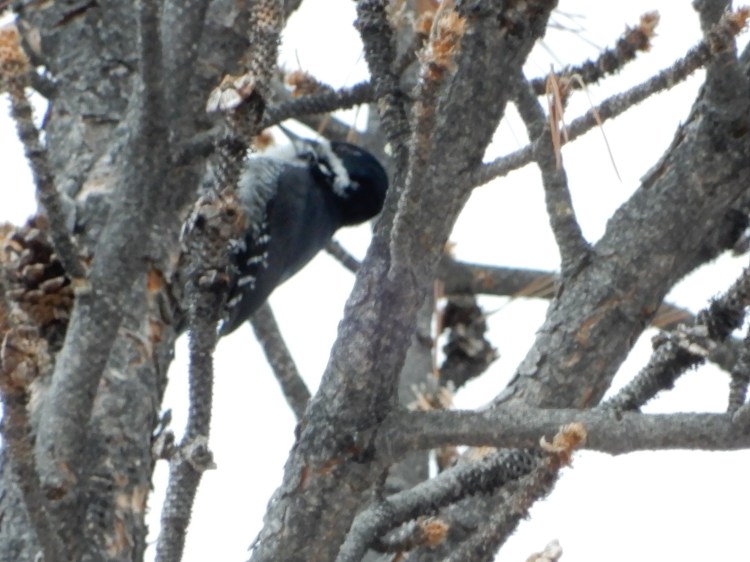
Black-backed Woodpecker 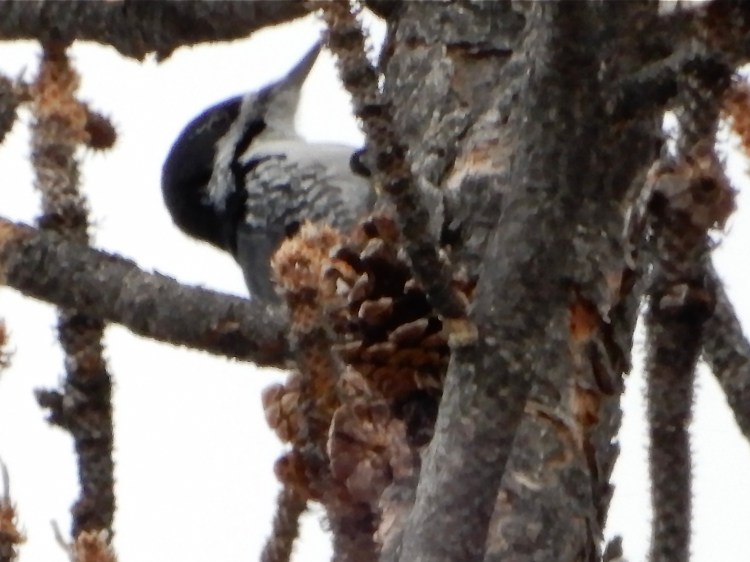
Black-backed Woodpecker
 Nature, every day.
Leave a Reply